
Customer Support vs Customer Service: The 7 Differences for SMBs
 Anahit Aleksanyan6 min read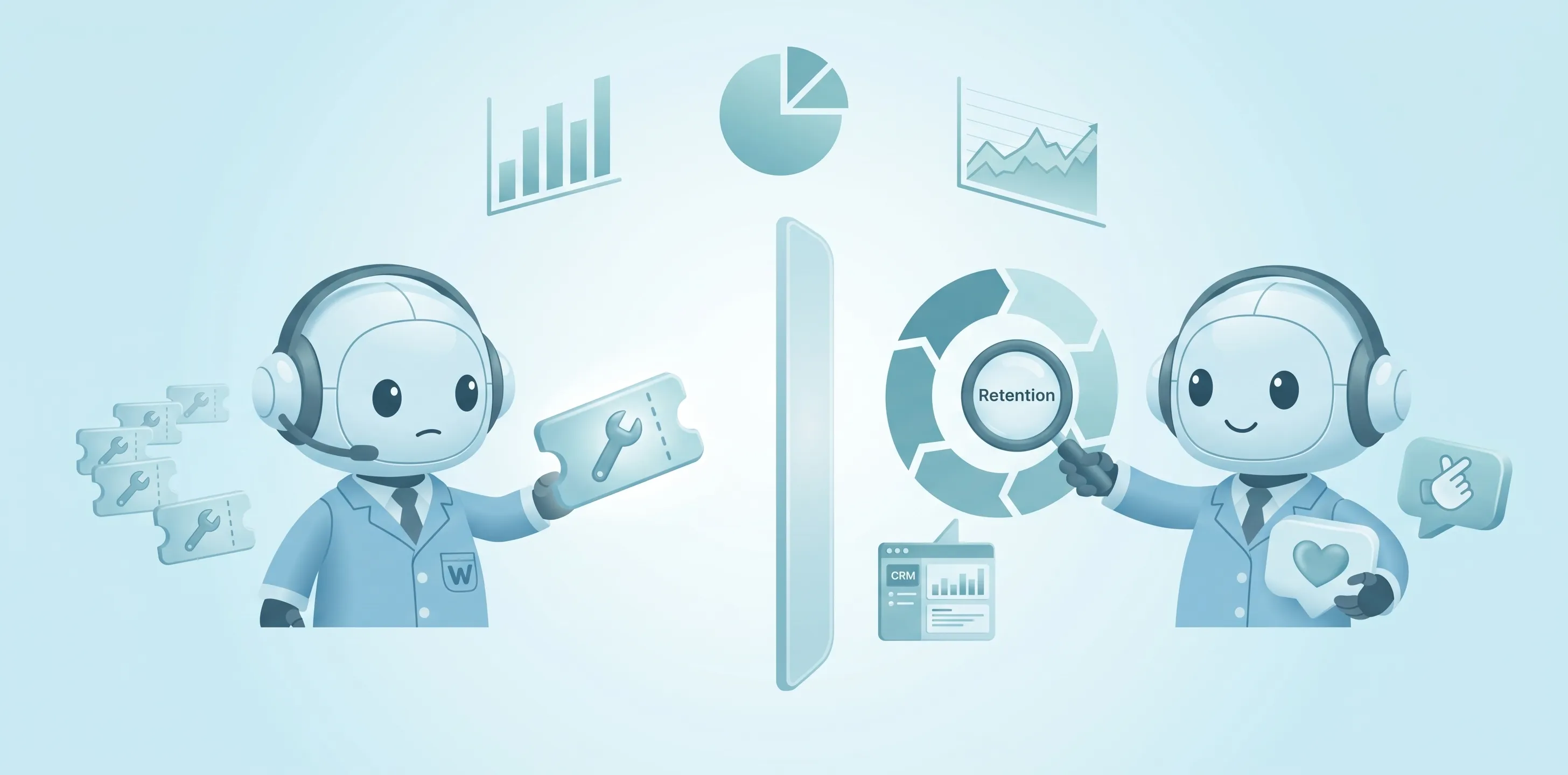
"Customer Support" and "Customer Service" get used like synonyms, but they're not the same thing.
"Customer Support" and "Customer Service" get used like synonyms, but they're not the same thing.
Customer service is the broad, ongoing relationship a business builds with its customers — before, during, and after a sale.
Customer support is the narrower, technical slice of that relationship: fixing a specific problem with a specific product.
For a small business deciding where to spend limited time and headcount, that distinction is worth knowing.
Flip the phrase around — customer service vs customer support — and the answer doesn't change: it's not about picking one, it's about knowing which one you're actually offering at any given moment.
Here are the 7 differences.
1. Scope: Broad Relationship vs. Narrow Problem-Solving
Customer service covers every touchpoint a customer has with your business — a pre-sale question, a billing issue, a follow-up after purchase, even a comment on social media. Customer support is narrower by design — sometimes called technical support — and exists to solve one specific, usually technical, problem with your product.
Service is the relationship. Support is the fix. "What's included in this plan?" is a service conversation. "The app crashed when I tried to export my file" is a support ticket.
2. Timing: Every Stage vs. Post-Purchase
Customer service runs across the entire customer journey — a lead asking questions before they buy is still a service interaction. Customer support almost always starts after the sale, once someone is actually using what they bought and hits a wall.
For SMBs, that split matters: service decides whether someone becomes a customer. Support decides whether they stay one.
3. Approach: Proactive-and-Reactive vs. Reactive
Good customer service is proactive as well as reactive — it anticipates questions and smooths friction before a customer has to ask.
Customer support is almost entirely reactive: it exists because something broke, not because someone's checking in.
Reactive doesn't mean slow. It means support only shows up when there's a problem to solve.
4. Skill Set: Empathy and Communication vs. Technical Know-How
Customer service runs on soft skills — listening, empathy, and the judgment to know when someone needs reassurance instead of a fix. These are the customer service skills that don't show up on a product spec sheet, but decide whether a conversation feels human.
Customer support runs on product depth — knowing the tool well enough to troubleshoot, reproduce a bug, or walk someone through a solution.
Most SMBs can't hire for both separately, so one person often ends up needing both skill sets in the same shift.
5. Metrics: Relationship Health vs. Resolution Speed
Customer service is measured in relationship terms: customer satisfaction (CSAT), net promoter score (NPS), retention, and customer lifetime value.
Customer support is measured in resolution terms: first response time, time to resolution, and customer effort score.
Track only one set, and you're flying half-blind. A team can resolve every ticket fast and still lose customers who feel like a transaction, or nurture a great relationship while support quietly falls apart underneath it.
6. Channels and Tools: Everywhere vs. Where the Problem Is
Customer service shows up wherever the customer already is — phone, email, social, in person. Customer support concentrates where troubleshooting actually happens — help desks, live chat, knowledge bases, self-service portals.
The two are converging fastest right here: Gartner expects self-service and live chat to overtake phone and email as the top customer service technologies within the next two years, as customers come to expect the same fast answer whether they're asking a service question or reporting a support problem. That shift is part of a broader move toward omnichannel customer service, where the line between a service touchpoint and a support ticket keeps getting blurrier.
7. Customer Support vs. Customer Service: Why the Distinction Actually Matters for SMBs
For a small business, this isn't semantics — it's a resourcing call. Bain & Company found that companies who excel at customer experience grow revenue 4% to 8% above their market average, and that gain requires getting both sides right, not just closing tickets fast.
But what if you get it wrong? Well, the damage is immediate: PwC found that 32% of customers would stop doing business with a brand they loved after just one bad experience.
That's a hard bar to clear with a small team and limited recources.
The Current Situation
Here's the uncomfortable number: 14% of customer service issues. The other 86% needs a real answer from somewhere — and for a small business, that "somewhere" is usually you, at 11 pm, on your own phone.
Welly answers first, on every channel, all day, and hands your team the rest with full context the second it counts — so the 86% of requests stop landing on you.
Change the Game with Welly's Help
If, just like most SMBs, you also can't staff service and support as two separate teams, we've got you.
Welly, your AI customer service agent, handles both service questions and support tickets across 7 channels from one trained knowledge base, and hands off to your team with full context the moment a conversation needs a person.
CTA - [Start Free Trial] (→ signup page)
FAQs
Is customer support the same as customer service?
No. Customer service is the broad relationship a business maintains across the whole customer journey. Customer support is the narrower, technical piece focused on solving product problems after a purchase — support is a type of service, not a synonym for it.
Which matters more for a small business — customer service or customer support?
Neither wins on its own. A business that's fast at technical fixes but cold on relationship-building still loses customers, and a warm relationship doesn't survive a broken product left unfixed. The real question for an SMB isn't which to prioritize; it's how to cover both without a two-department budget.
Can one person really handle both customer service and customer support?
Yes — most SMBs already do this by necessity, just rarely by design. The skill sets differ (empathy versus technical troubleshooting), so the real risk is one side slipping when the other gets busy.
Is automated customer support realistic for a small business?
Increasingly, yes. Tools built for automated customer support — often powered by an AI customer service agent — now handle the repetitive, always-on parts of both service and support — answering common questions, routine troubleshooting — and loop in a person for anything that needs judgment. That's a lighter lift than hiring a second team, and it's the gap WellyOn is built to close.